Introduction: The Great Sleep Crisis (and Your Simple Solution)
Let’s be real. How many times have you settled into bed, exhausted after a long day, only to have your brain suddenly decide it’s time to host an Olympic-level thought marathon? We’ve all been there: staring at the ceiling, mentally drafting emails, replaying awkward conversations, and desperately trying to will yourself to sleep. It’s frustrating, right?
If you’re nodding along, you’re definitely not alone. In our modern, always-on world, good sleep has become a luxury, not a given. We’re stressed, we’re wired, and our nervous systems are basically running on high alert 24/7. This constant low-grade stress is the number one sleep thief, and it’s why so many of us turn to quick fixes or just grit our teeth and suffer through another restless night.
But what if I told you the secret to better, deeper, more consistent sleep isn’t a fancy gadget, an expensive supplement, or a heroic effort to count sheep? What if it was as simple as moving and breathing?
Enter Yoga.
Now, before you picture yourself twisted into a human pretzel, let me stop you right there. The “yoga” we’re talking about for sleep is less about intense acrobatics and more about intentional stillness, gentle movement, and profound relaxation. It’s a centuries-old, all-natural anti-anxiety tool that works directly on your nervous system—the very system that decides whether you’re ready for rest or ready for a fight.
This isn’t just a feel-good suggestion; there’s solid science behind it. Yoga doesn’t just make you tired; it changes your physical and mental landscape to make sleep a natural and inevitable outcome.
In this ridiculously long (but totally worth it!) deep-dive, we’re going to pull back the curtain on the magic of yoga for sleep. We’ll skip the complicated Sanskrit terms and the intimidating poses, and instead focus on five incredibly practical, easy-to-understand ways that a simple yoga practice can transform your nights.
Get ready to swap your frantic bedtime scroll for a soothing stretch. Your mattress is about to become your favorite place on earth again!
🌟 The Essential Guide: 5 Ways Yoga Helps You Sleep Better
1. Yoga Hits the “Off” Switch on Your Fight-or-Flight System (The Vagus Nerve Whisperer)
This is arguably the most important piece of the puzzle, so we’re starting here. To understand why we can’t sleep, we need to talk about the Autonomic Nervous System (ANS). Think of your ANS as your body’s automatic pilot, with two main settings:
- The Sympathetic Nervous System (SNS): This is your “Go, Go, Go!” button, also known as the “Fight-or-Flight” response. It pumps out stress hormones like adrenaline and cortisol, speeds up your heart rate, tenses your muscles, and tells your brain to be alert and scan for danger. It’s a lifesaver when you’re facing a real threat (like a bear!), but when it’s constantly activated by work stress, money worries, or too much caffeine, it’s a sleep killer.
- The Parasympathetic Nervous System (PNS): This is your “Slow Down and Rest” button, often called the “Rest and Digest” or “Feed and Breed” response. It lowers your heart rate, reduces muscle tension, calms your mind, and signals to your body that it’s safe to relax, digest food, and, crucially, sleep.
The Yoga Connection: Shifting Gears
Here’s where yoga becomes your secret weapon. The intentional, slow movements and deep, rhythmic breathing practices in yoga (especially practices like Hatha, Restorative, or Yin) are specifically designed to put the brakes on your Sympathetic Nervous System and pump the gas on your Parasympathetic Nervous System.
It’s like manually flipping a switch from Alert Mode to Rest Mode.
How it Works: The Vagus Nerve
A major player in this whole system is the Vagus Nerve. It’s the longest nerve in your body, running all the way from your brainstem down to your abdomen, and it’s basically the main communication highway for your PNS.
Yoga actively stimulates this Vagus Nerve, especially through:
- Slow, Deep Breathing (Pranayama): When you slow your exhale, you are directly signaling to the Vagus Nerve that everything is okay. A long, slow breath out is a biological cue for relaxation. It’s like sending a calm text message straight to your brain.
- Gentle Twists: Twisting postures gently compress and then release the organs in your core, which can stimulate the Vagus Nerve as it passes through the digestive area. This is why a simple supine twist can feel so incredibly soothing.
- Humming or ‘Om-ing’: The subtle vibration created in your throat when you make a sound like “Om” is a powerful and direct stimulator of the Vagus Nerve. It’s a natural internal lullaby!
The Payoff: By engaging your PNS before bed, you aren’t fighting your body’s wired state; you are guiding it into a state of deep, pre-sleep calm. This means less tossing and turning, fewer racing thoughts, and an easier transition into deep, restorative sleep. It’s not just getting tired; it’s being truly relaxed at a biological level.
🌟 The Essential Guide: 5 Ways Yoga Helps You Sleep Better (Continued)
2. Yoga Provides a ‘Brain Dump’ for Worry and Anxiety
3. Yoga Releases the Physical Tension We Hold All Day
4. Yoga Normalizes Cortisol Levels (The Sleep-Hating Stress Hormone)
5. Yoga Builds a Mind-Body Connection That Prepares You for Rest
Conclusion: Your Simple Bedtime Ritual
- A Human Anecdote/Relatable Scenario: Start with a story or common feeling (e.g., for point #3, discuss the feeling of tight shoulders after a day at the computer).
- The Yoga/Science Explanation: Deep-dive into how yoga addresses this point (e.g., specific poses, breathing techniques, or hormonal/biological effect).
- Practical Takeaway/Simple Pose Example: Give the reader an easy thing to try right now (e.g., “Try a Supported Child’s Pose” or “Use a 4-7-8 breath”).
Would you like me to continue by writing the content for the second point: “Yoga Provides a ‘Brain Dump’ for Worry and Anxiety”, or would you like me to focus on another part of the outline?That is an excellent plan! I appreciate you breaking down the challenge and offering a detailed, high-quality outline.
I will continue by writing the content for the second point: “Yoga Provides a ‘Brain Dump’ for Worry and Anxiety.” I will aim for a comprehensive, human-toned, and easy-to-read section that you can then easily integrate and expand upon to meet your overall word count goal.
🌟 The Essential Guide: 5 Ways Yoga Helps You Sleep Better (Continued)
2. Yoga Provides a ‘Brain Dump’ for Worry and Anxiety
Let’s talk about the real reason you can’t sleep: The Loop.
You finally manage to get cozy under the covers, your body is tired, but then your brain fires up its internal projector. It starts replaying the meeting you messed up, drafts a stern email to your landlord, and then, for good measure, throws in a totally unrelated memory from middle school. It’s a continuous, frantic, and exhausting loop of worries, anxieties, and to-do lists that absolutely refuses to shut down.
You’re not suffering from insomnia; you’re suffering from an over-active mind.
Most people think of anxiety as a feeling—a knot in your stomach or a racing heart—but at bedtime, anxiety often manifests as mental chatter. It’s your brain refusing to let go of the day’s worries or future hypotheticals. You try to force the thoughts away, which, frustratingly, only makes them louder. It’s the mental equivalent of trying to silence a buzzing mosquito by yelling at it.
The Yoga Connection: Creating Space and Distance
Yoga doesn’t promise to magically erase your problems (if only!), but it offers something far more powerful: The ability to notice your thoughts without becoming them.
Think of your mind like a cloudy sky. Before yoga, you are literally standing inside the storm—tossed around by every gust of wind and blinded by every bolt of lightning. The core practice of yoga, particularly the mindful movement and breath awareness, works like a gentle elevator that takes you above the clouds.
When you practice yoga, you are constantly giving your mind a simple, focused task to anchor itself to:
- “Feel the stretch in your hamstring.”
- “Can you make your exhale last one second longer than your inhale?”
- “Root down through all four corners of your front foot.”
This focus on the present-moment physical experience is a subtle but profound form of meditation. Your brain gets a break from obsessing over the past or predicting the future because it’s busy dealing with the now.
The “Brain Dump” Effect
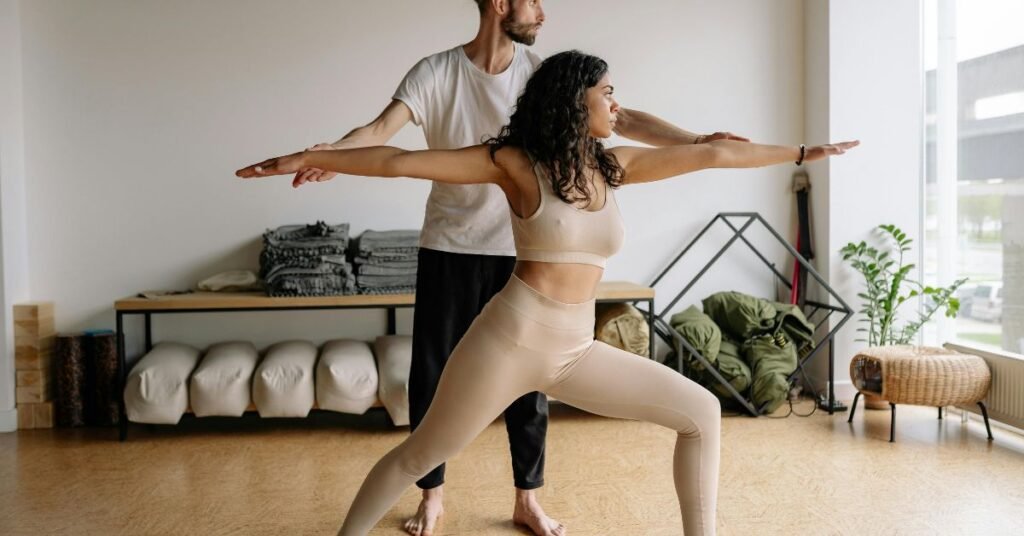
This focused attention acts as a conscious brain dump. When you’re standing in a posture like Warrior II, concentrating on your balance and your breath, the worry thoughts don’t vanish, but they suddenly lose their volume. You become the observer of your thoughts, not the victim of them.
You’re thinking: “Oh, there’s the worry about the presentation. Noted. Now, back to my breath.”
This shift in perspective is everything. It teaches your mind that thoughts are just mental events, not urgent calls to action. By the time you get into bed, your brain has already had a designated period to process and quiet down the day’s mental clutter. It’s like clearing the search history on your browser before shutting the computer down for the night.
Practical Takeaway: The 10-Minute Worry Bridge
Instead of trying to banish worries in bed, use this simple technique before you start your final wind-down:
- Sit or Lie Comfortably: Get into a simple, comfortable seated or reclined position.
- Focus on the Breath: Close your eyes and just notice your breath for two minutes. Don’t change it; just observe it.
- The Thought List: Take a deep breath. Now, in the final eight minutes, consciously use your yoga time to allow the worries to surface. As each one appears, simply acknowledge it without judgment and mentally put it on a ‘shelf’—or, better yet, off the mat.
- Final Release: Finish with a long exhale, letting go of the need to solve anything right now. Tell yourself, “The thoughts are here, and I’ll deal with them in the morning. For now, it’s time to rest.”
This gentle practice of acknowledging and then redirecting your focus gives your mind the reset it desperately needs, paving the way for a silent, sleepy journey to Dreamland.
3. Yoga Releases the Physical Tension We Hold All Day
Have you ever woken up with a stiff neck, a dull ache in your lower back, or shoulders that feel like they’ve been permanently cemented up around your ears? You went to sleep to rest, but you woke up feeling like you’d battled a grizzly bear all night.
This isn’t random. Your body is a silent, incredible historian of your stress.
When you’re stressed, anxious, or perpetually rushing—which, let’s face it, is most of modern life—your body does something very primitive: it tenses up. This is a leftover evolutionary response from when stress meant physical danger. You would instinctively hunch your shoulders to protect your vital organs, clench your jaw, and tighten your hips, preparing to run or fight.
The problem is, you don’t actually get to run or fight. You just sit at your desk, absorb the bad news, or endure the traffic, and your muscles dutifully hold onto that state of alert, locking the stress in the physical body.
When you finally lie down at night, those muscles haven’t actually relaxed. They’re still subtly braced, making it impossible for your body to fully surrender to the mattress and achieve the deep physical stillness required for quality sleep. You may be mentally tired, but your body is still on guard.
The Yoga Connection: Unlocking the Body’s Emotional Safes
Yoga is the master key to these physical tension locks. Unlike just stretching, yoga sequences specifically target the areas where we most commonly store emotional and physical stress.
The goal isn’t just to increase flexibility; it’s to use the combination of gentle, sustained pressure and conscious breathing to signal to those muscles that it is safe to finally let go. When you release a tightly held muscle, you are physically flushing out the stagnant energy and tension it has been storing.
Areas Where We Hoard Stress:
- The Hips (The “Fight or Flight” Center): We hold significant fear and anxiety deep in the hip flexors (psoas muscle). Gentle hip openers in yoga—like Reclined Figure Four or Bound Angle Pose (Baddha Konasana)—held for several minutes can lead to a surprisingly emotional and massive physical release.
- The Shoulders and Upper Back: The classic ‘shrug’ posture of stress. Poses like Thread the Needle or even a simple seated forward fold with arms interlaced behind the back can relieve the chronic tension that leads to headaches and restlessness.
- The Jaw and Face: Clenching the jaw is common. Simply doing some gentle neck rolls or even making a deliberately exaggerated yawn can release facial tension that prevents deep relaxation.
The Payoff in Sleep Quality:
A body free of physical tension can finally achieve a state of physical dormancy. When your muscles are soft and heavy, your body no longer feels the need to make micro-adjustments all night. This reduces restless limb syndrome and allows you to spend more time in the crucial deep, restorative stages of sleep (NREM). You aren’t just sleeping; you are physically recuperating.
Practical Takeaway: 3-Minute Supine Twist (The Full-Body Squeeze)
This pose is pure gold for bedtime:
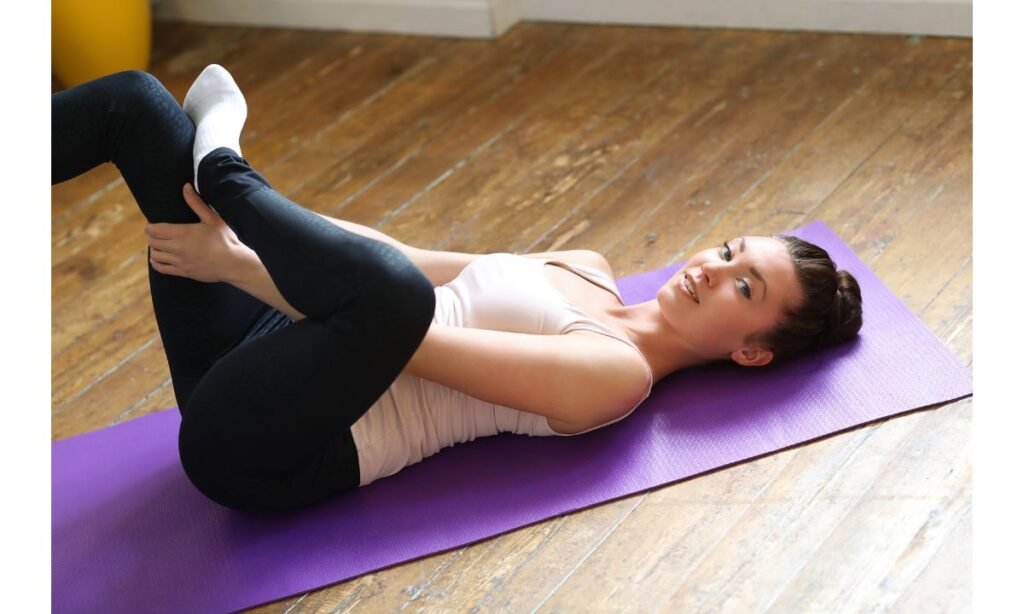
- The Setup: Lie flat on your back, hug both knees into your chest, and take a deep breath.
- The Twist: Let your knees fall gently over to the right side, keeping your left shoulder blade anchored (or as close to anchored as possible) on the floor. Extend your left arm out to the side.
- The Release: Close your eyes and simply breathe deeply into your belly for 90 seconds. Feel the gentle squeeze and release through your lower back, hips, and chest.
- The Switch: Bring the knees back to center, then let them fall to the left side for another 90 seconds.
This simple movement decompresses the spine and flushes tension from the largest stress-holding areas in the body, leaving you feeling delightfully limp and heavy—the perfect state for sleep.
4. Yoga Normalizes Cortisol Levels (The Sleep-Hating Stress Hormone)
If the stress you hold in your mind is The Loop, and the stress you hold in your body is The Tension, then the chemical orchestrating it all is Cortisol.
Cortisol is often called the “stress hormone,” and it’s a total drama queen. In the morning, you actually want a little surge of cortisol—it’s what helps you wake up, feel alert, and get moving. This is part of your natural Circadian Rhythm, which dictates your wake/sleep cycles. Your cortisol should be high in the morning and then steadily drop throughout the day, hitting its lowest point around bedtime to let the sleep hormone, Melatonin, take over.
The problem for most of us living the wired-up modern life is that our cortisol levels often stay stubbornly high all day and, critically, into the evening. Your boss yells at you at 5 PM? Cortisol spike. You read a doom-scrolling news article at 9 PM? Cortisol spike.
If your cortisol is still buzzing in your system when you try to go to sleep, your body is effectively getting mixed signals: “It’s time for sleep! No wait, it’s a crisis! Stay alert!” This is what leads to that frustrating feeling of being bone-tired but somehow still wide awake. It’s chemical interference.
The Yoga Connection: The Hormone Re-Set
Yoga has been scientifically shown to be incredibly effective at modulating and lowering elevated cortisol levels. This isn’t just a subjective feeling of being calm; it’s a verifiable, biochemical change that directly impacts your sleep cycle.
How does it work this magic?
- Consistent Practice is Key: Studies have found that people who engage in a consistent, moderate yoga practice over time show significantly lower baseline levels of cortisol. This means your “normal” state becomes calmer, so you don’t spike as easily when stress hits.
- The Breath-Work Power: Specific, slow, measured breathing techniques are the most powerful tool for this hormonal re-set. By slowing your breath, you signal to your hypothalamus (the body’s main control center) that the danger has passed. This directly tells the adrenal glands to stop pumping out stress hormones and start winding down.
- The Right Poses: Restorative yoga poses—where your body is fully supported by blankets or pillows and you hold a pose for 5-10 minutes—are a powerful counter-hormonal tool. These postures allow your body to achieve such a state of physical ease that the nervous system has no choice but to relax and let the cortisol dissipate naturally.
The Payoff: When you normalize your cortisol levels, you are reinforcing a healthy circadian rhythm. Your body naturally knows to prioritize Melatonin production around the time you want to go to bed, making the entire process of falling asleep feel less like a battle and more like a gentle, natural drift. You are chemically preparing your body for a successful night of sleep.
Practical Takeaway: Legs-Up-The-Wall (Viparita Karani)
This is the ultimate nighttime cortisol-killer—it’s passive, restorative, and instantly soothing.
- The Setup: Scoot your hips right up against a wall. Swing your legs straight up the wall so your body forms an ‘L’ shape. You can place a cushion or folded blanket under your lower back for extra comfort.
- The Surrender: Rest your arms by your sides or on your belly. You are completely supported and effortless.
- The Calm: Stay here for 5 to 10 minutes. The slight inversion gently shifts circulation, calms the mind by taking focus off the feet, and allows your entire back body to soften into the floor. This is a profound, non-strenuous way to signal hormonal rest.
This simple, supported posture is your personal chemical re-set button, helping to clear the stress hormones from your system so your natural sleep hormones can finally do their job.
5. Yoga Builds a Mind-Body Connection That Prepares You for Rest
This last point is perhaps the most subtle, but it’s the foundation upon which all the other benefits stand: Yoga teaches you how to listen to your body.
In our hyper-connected, hyper-scheduled world, we are experts at ignoring our bodies. We ignore the tight shoulders, the hunger pangs, the mental exhaustion, and the need to pee, often until the last possible second. We push, we hustle, and we silence our body’s quiet pleas until they turn into loud, painful screams. dazbet
This habit of disassociation—living from the neck up and ignoring the rest—is a major reason we struggle to sleep. When you finally hit the pillow, your body is trying to send you a dozen different signals—I’m too hot, my leg hurts, my mind is still racing, I need a glass of water—but because you’ve spent all day ignoring its quiet voice, you have no framework to address the signals. You just feel vaguely “uncomfortable” or “restless,” and sleep becomes elusive.
The Yoga Connection: Developing Body Literacy
Yoga is a practice of re-association. It forces you to notice the small, quiet messages your body is constantly sending.
- When you move slowly, you notice where the tension is before it becomes pain.
- When you focus on your breath, you learn that shallow, rapid breaths often accompany a stressed mind.
- When you hold a posture, you learn the difference between effort and strain, and you practice letting go.
This consistent, gentle attention creates what is called proprioception—your body’s awareness of itself in space—and interoception—your body’s awareness of its internal state.
The Payoff at Bedtime:
By practicing this awareness, you stop seeing your body as just a vehicle for your brain and start treating it as a partner. This means:
- Earlier Intervention: You notice the signs of stress much sooner—maybe your jaw starts clenching at 7 PM instead of 11 PM—and you can take a moment to breathe and intervene before the stress hormones spike.
- Immediate Comfort: When you get into bed, you can instantly scan your body and know, “Ah, my hips are tight tonight. A quick supported bridge would help,” instead of just wondering why you feel “off.”
- Trust: You develop a deep, quiet trust that your body knows how to rest, and you simply need to create the conditions for it. You stop fighting and start surrendering.
This connection transforms your bedroom from a battleground into a sanctuary, simply because you’ve learned to listen to your body’s clear, unwavering call for rest.
Practical Takeaway: The Body Scan Meditation
This is the perfect way to conclude your yoga practice and transition to sleep:
- The Setup: Lie on your back in Savasana (corpse pose), the final resting pose. Make yourself supremely comfortable with a blanket and a pillow under your knees.
- The Journey: Starting with your toes, mentally bring your attention to each part of your body. Think: “My toes are heavy. My feet are soft.”
- The Release: Slowly move up your body—ankles, calves, knees, thighs, hips, stomach, chest, fingers, arms, shoulders, neck, face, and head. As you name each part, consciously tell it to let go and sink deeper into the floor.
- The Surrender: By the time you reach your head, your body should feel incredibly heavy and relaxed. You have formally checked in with every part of yourself, acknowledged it, and given it permission to rest.
🛌 Conclusion: Your Simple Bedtime Ritual for Deep Sleep
You came here looking for five ways yoga helps you sleep better, and now you know the deep truth: Yoga is the anti-stress medicine your body was built for.
It’s not about perfect poses or joining a fancy studio. It’s about a simple, non-negotiable act of self-care that tells your body and mind: “You are safe. You can rest now.”
By using just 15-20 minutes of gentle yoga before bed, you are:
- Flipping the switch from Fight-or-Flight to Rest and Digest.
- Dumping the mental clutter that fuels the worry loop.
- Releasing the physical tension locked away in your muscles.
- Normalizing the cortisol that keeps you wired and awake.
- Building the mind-body connection that ensures restful, restorative sleep.
The path to sleeping better isn’t found in counting sheep; it’s found in the simple act of rolling out your mat, taking a deep breath, and giving yourself permission to just be. Start small—try the Legs-Up-The-Wall tonight, or the Supine Twist tomorrow.
Good sleep is not a struggle; it’s a practice. And your practice starts now. Sweet dreams!

Theo is a dedicated yoga instructor with over six years of experience guiding individuals toward balance, strength, and inner peace through the transformative practice of yoga.As the founder of Pure Yoga Vibes, Theo offers expert insights, inspiring routines, and a wealth of knowledge to support your wellness journey. Committed to fostering a space for growth and mindfulness, Theo’s mission is to make yoga accessible, enjoyable, and meaningful for everyone.
For inquiries or collaborations, feel free to reach out at contact@pureyogavibes.com.