Introduction: Hey You, Thinking Too Much?
Ever had your brain turn into a popcorn machine at 2 a.m.? Thoughts bouncing everywhere — “Did I send that email?” “What if I embarrass myself tomorrow?” “Why did I say that in 2012?” Welcome, my friend, to the club of overthinkers.
Overthinking is exhausting. It’s like running a mental marathon while sitting still. You want to stop, but your mind won’t let you. The good news? You can quiet the mental noise — and you don’t need to become a monk or delete social media (though, let’s be honest, that might help too).
What you need is slow, intentional movement. That’s right — yoga. But not the intense, twist-your-body-into-a-pretzel kind. We’re talking slow yoga — grounding poses, gentle flows, and breathing that actually makes your brain feel like it’s finally had a nap.
In this post, we’ll talk about:
- Why overthinking happens and how it affects your body.
- Why slow yoga is a perfect antidote to the brain spiral.
- Specific yoga poses and flows designed to calm the storm.
- Tips to stay present and make yoga a regular part of your de-overthinking plan.
So roll out your mat, kick off your shoes, and let’s start untying the knots — in your body and your mind.
The Overthinker’s Brain: A Wild Party No One Asked For
Before we dive into movement, let’s get one thing straight: overthinking is normal. It’s your brain trying to solve problems. The issue? It doesn’t always know when to stop.
Common signs you’re overthinking:
- Replaying conversations on loop.
- Imagining worst-case scenarios like you’re a screenwriter for a disaster movie.
- Decision paralysis — even choosing cereal feels like a life-or-death matter.
- A constant “buzz” in the brain, even when your body is still.
Sound familiar?
Overthinking triggers your nervous system. Your body tightens. Your shoulders creep up to your ears. Your jaw clenches. Your breath gets shallow. Basically, your body thinks you’re running from a bear, but really, you’re just wondering if that text sounded weird.
Why Slow Yoga Helps (It’s Science, Not Just Vibes)
Slow yoga isn’t just about stretching. It’s about rewiring your nervous system. When you move slowly and breathe deeply, you signal your body: “Hey, we’re safe. No bears here.”
Here’s what slow yoga can do:
- Activates the parasympathetic nervous system — aka the “rest and digest” mode.
- Releases physical tension — less tension = fewer anxiety signals sent to the brain.
- Brings attention to the body — shifting focus away from spinning thoughts.
- Improves breathing — slower breaths = calmer mind.
- Builds mindfulness — the opposite of spiraling.
The best part? You don’t need fancy clothes, expensive mats, or to be “flexible.” All you need is your breath, some floor space, and a willingness to show up.
Setting the Scene: Make Your Practice Your Peace
Before we get into poses, let’s set the vibe. You can’t just plop onto your mat in a tornado of to-do lists and expect your brain to magically chill. You need a transition.
Create a calming space:
- Lights: Dim them or light a candle. Your brain loves soft lighting.
- Sound: Gentle music or silence — whatever feels peaceful.
- Smell: Lavender, eucalyptus, or frankincense essential oils can help.
- Phone: Silent. Airplane mode. Throw it across the room (gently).
Mindset matters:
- Let go of expectations. This is not about “doing it right.”
- Be curious, not critical. “Hmm, interesting” is your new mantra.
- If your brain wanders, that’s okay. Gently bring it back — like herding cats.
The Overthinker’s Yoga Flow: Slow, Grounded, Gentle
Let’s move. These poses are designed to calm your nervous system, bring you into your body, and quiet your mind — not through force, but through softness.
1. Constructive Rest Pose (Savasana with Knees Bent)
- Lie on your back.
- Bend your knees, feet flat on the floor.
- Place your hands on your belly or by your sides.
- Close your eyes.
Why it helps: This pose signals your body to relax and supports your spine. Focus on the breath moving in your belly.
2. Cat-Cow (Marjaryasana-Bitilasana)
- On hands and knees.
- Inhale: arch your back, lift your tailbone and head (Cow).
- Exhale: round your spine, tuck chin to chest (Cat).
- Repeat slowly.
Why it helps: Gently mobilizes your spine and connects breath with movement.
Do for: 1–2 minutes.
3. Child’s Pose (Balasana)
- Knees wide, big toes touching.
- Sit back on your heels, forehead on the mat.
- Arms stretched forward or by your sides.
Why it helps: Deeply calming. Feels like being hugged by the earth.
Stay for: 3–5 minutes.
4. Seated Forward Fold (Paschimottanasana)
- Sit with legs straight out.
- Inhale: lengthen spine.
- Exhale: fold forward, reach toward feet or shins.
Why it helps: Grounding and inward-focused. Releases hamstrings and mind tension.
Hold for: 1–2 minutes. Use a pillow on your legs for support.
5. Legs Up the Wall (Viparita Karani)
- Lie on your back, legs up against the wall.
- Arms relaxed at your sides.
Why it helps: Soothes the nervous system. Reduces anxiety, improves blood flow.
Stay for: 5–10 minutes.
6. Supine Twist
- Lie on your back.
- Pull right knee to chest.
- Gently guide it across the body with left hand.
- Right arm opens to the side.
Why it helps: Relieves tension, especially in the back. Twists release mental clutter.
Hold: 1 minute per side.
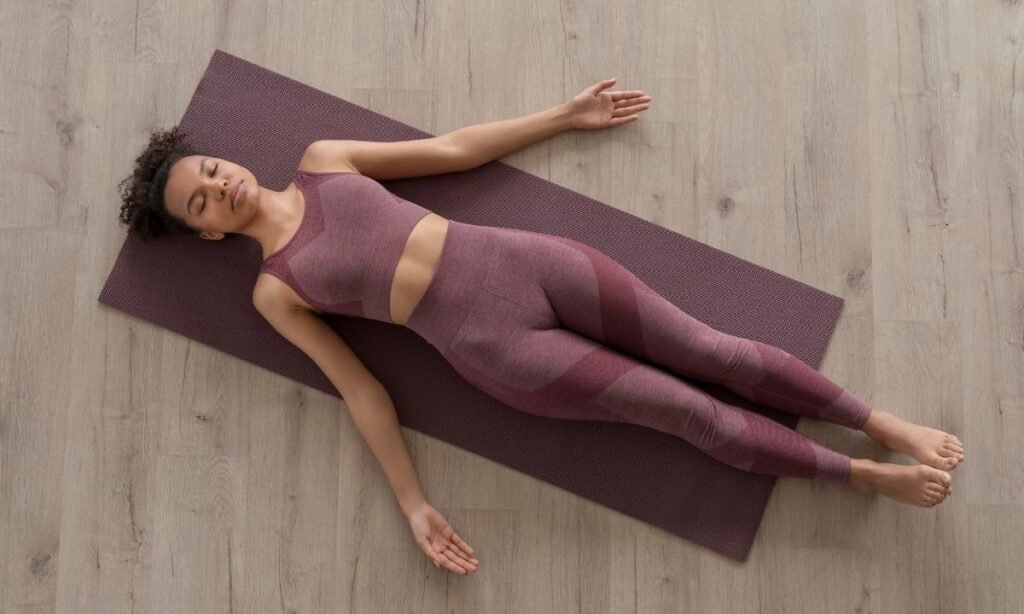
7. Savasana (Final Resting Pose)
- Lie flat, legs and arms relaxed.
- Let your body melt into the floor.
Why it helps: Allows your body and brain to integrate everything. Deep peace.
Stay for: 5–10 minutes. No rushing.
Add the Magic: Breath + Intention
Breath is your anchor. It keeps you from drifting into thought loops.
Try this breath pattern:
4-7-8 Breathing
- Inhale for 4 counts.
- Hold for 7 counts.
- Exhale for 8 counts.
Do this 4 times before starting and after your flow. It’s like a nervous system reboot.
Real Talk: Your Brain Will Wander — That’s Okay
Let’s not pretend that after one yoga session, your mind will be silent like a peaceful monk sipping tea in the Himalayas.
You’ll think about dinner.
You’ll wonder if your breath sounds weird.
You’ll remember that awkward joke you told in a meeting last week.
That’s normal. The point isn’t to stop thoughts. It’s to notice them, gently return to the breath or the pose, and repeat.
Like training a puppy. With love. And snacks, if needed.
Tips to Make Yoga a Habit (Even if You’re Busy or Forgetful)
Let’s be honest — starting something new is easy. Sticking to it? Whole different story.
Here’s how to make slow yoga part of your daily life:
1. Start tiny
5 minutes > 0 minutes. Even one pose counts.
2. Tie it to a habit
Do yoga after brushing your teeth or before bed. Link it to something you already do.
3. Make it enjoyable
Use music you love. Light a candle. Use a cozy blanket. Turn it into a ritual.
4. Track it
Use a calendar, sticker chart, or app. Celebrate showing up.
5. Be gentle
Miss a day? Overthought yourself into a nap instead? That’s okay. Just begin again.
Beyond the Mat: Taking the Calm Into Your Life
Slow yoga teaches us a beautiful truth: you don’t have to rush to make progress.
Apply this mindset elsewhere:
- In conversations, pause before responding.
- At work, take one thing at a time.
- In decision-making, breathe first — then act.
- During anxious moments, return to your breath like it’s home.
You don’t need to think your way out of overthinking. You need to move your way out.
Real People, Real Results
Here’s what some fellow overthinkers have said after adding slow yoga to their lives:
“It’s the only time my brain isn’t racing. Even if it’s just 10 minutes, I feel like I reboot.” – Sarah, 34
“I thought yoga was about flexibility, but now I realize it’s more about focus. My anxious energy finally has somewhere to go.” – Jordan, 27
“I used to spiral before bed. Now I do Legs Up the Wall and some breathwork, and I actually sleep.” – Reema, 41
You’re not alone. And you’re not stuck.
Final Thoughts: You Deserve a Quiet Mind
Let’s not sugarcoat it — overthinking is tough. It hijacks your peace, steals your energy, and makes everyday life harder than it needs to be.
But here’s the hope: your mind can learn to soften. Your thoughts can slow down. Your nervous system can reset.
Not through pressure.
Not through perfection.
But through presence.
And yoga — slow, gentle, grounded yoga — is one of the best tools to get there.
So next time your brain starts spinning, try this instead:
Lay down.
Breathe slow.
Move gently.
And remember — you are not your thoughts.
You are the stillness underneath.
Ready to start? Bookmark this post. Roll out your mat. And give yourself the gift of five slow breaths. That’s it. You’re already doing it.
Namaste, fellow overthinker. You’ve got this.

Theo is a dedicated yoga instructor with over six years of experience guiding individuals toward balance, strength, and inner peace through the transformative practice of yoga.As the founder of Pure Yoga Vibes, Theo offers expert insights, inspiring routines, and a wealth of knowledge to support your wellness journey. Committed to fostering a space for growth and mindfulness, Theo’s mission is to make yoga accessible, enjoyable, and meaningful for everyone.
For inquiries or collaborations, feel free to reach out at contact@pureyogavibes.com.