An Introduction: The Stretch That Changes Your Soul
Let’s be honest. When most people think of “Yoga,” what pops into their head? Is it a picture of a wise sage sitting motionless on a mountaintop, radiating peace? Probably not. More likely, it’s a packed studio, people sweating through a particularly ambitious Warrior Three pose, or maybe someone finally managing to touch their toes without groaning too loudly. For a long time, the Western world—and maybe even a part of you—has viewed yoga as just a really good workout.
You know the drill: it makes your back feel better, gives you those lovely, long, lean muscles, and maybe, just maybe, calms your racing mind for an hour. It’s the ultimate physical and mental tune-up.
But what if I told you that treating yoga as just a form of exercise is like looking at the entire history of human literature and only focusing on the cover font? What if I told you that the physical poses (asanas) you practice are, quite literally, just one tiny, single branch of an ancient, sprawling, and incredibly profound tree of wisdom?
The truth—the one we’re going to dive deep into today—is that Yoga is, at its heart, a spiritual system. It is a meticulously mapped-out, time-tested technology for self-realization and spiritual growth. It’s a journey designed to take you from the surface level of who you think you are (your worries, your job, your to-do list) to the deep, silent core of who you actually are (your purpose, your peace, your indestructible essence).
This isn’t about joining a cult, abandoning your life, or even becoming a vegan (unless you want to!). This is about unlocking an inner power you didn’t know you had.
What You’ll Discover in This Comprehensive Guide (Don’t Worry, We Keep It Easy!):
- The Big Picture: We’ll strip away the Sanskrit and the complex terms to explain the real goal of yoga—it’s bigger than flexibility, trust me.
- The Eight-Limbed Map: A detailed, human-friendly walk-through of Patanjali’s Ashtanga Yoga, the ancient 8-step blueprint for a spiritually fulfilling life.
- The Unspoken Benefits: How learning to not steal (Asteya) or be truthful (Satya) actually makes your Downward Dog better and your life richer.
- Your Real-Life Toolbox: Practical ways to use the deeper, non-physical principles of yoga right now, whether you’re stuck in traffic, dealing with a difficult boss, or just trying to get through Monday.
- Human Stories of Change: Real-life examples of people whose lives were completely transformed when they stopped “doing” yoga and started living it.
Ready to see how a simple forward fold can turn into an act of profound self-discovery? Let’s stop talking about tight hamstrings and start talking about soul stretching.
Part 1: Defining the Spiritual Journey — What Yoga Really Is
Before we get to the spiritual skyscraper, we need to look at the foundations. What does the word “yoga” actually mean?
It doesn’t mean “stretching.” The Sanskrit word Yoga means “to yoke,” “to join,” or “to unite.”
The Great Union: Puruṣa and Prakṛti (The Un-Complicated Version)
Union with what, exactly? This brings us to the core philosophical nugget of classical yoga, which is based on the Samkhya school of thought. Let’s make this simple:
- Puruṣa (Pure Consciousness): Think of this as your true, unchanging Self—the ultimate “I Am.” It’s the quiet, passive witness. It is perfect, peaceful, and totally unaffected by anything that happens in the world. It is your soul.
- Prakṛti (Nature/Matter): This is everything else. Your physical body, your emotional rollercoaster, your chattering mind, the phone you’re reading this on, the coffee you just spilled—it’s all the dynamic, ever-changing stuff of the material world.
The core teaching is this: You are Puruṣa, but your consciousness has become confused and completely identified with the stuff of Prakṛti—specifically, your mind and ego. You think your messy, worried, stressed-out mind is you.
The ultimate spiritual goal of Yoga is Mokṣa (Liberation) or Samadhi (Union): to gently, slowly, and systematically un-mix your pure consciousness from the noisy chatter of your mind, allowing you to realize that you are the eternal, blissful witness. This is the spiritual growth we’re talking about—a complete, unshakeable shift in identity.
The Mind: The Biggest Yoga Pose of All
The classical text that mapped out this entire process is the Yoga Sutras of Patanjali. Patanjali gives us the most famous and concise definition of yoga in the second sutra:
“Yoga is the cessation of the movements of the mind.” (Yogaś citta vṛtti nirodhaḥ)
Think about that for a second. It doesn’t say, “Yoga is the ability to do a headstand.” It says the goal is to stop the constant, frantic waves of thought (the vṛttis or “whirlpools of the mind”) so that your true self (Puruṣa) can be clearly seen, like the reflection of the sun on a still lake.
The physical poses are simply a brilliant, clever tool designed to prepare the Prakṛti (the body and mind) so it can sit still long enough for the Puruṣa to shine through. The body must be strong, flexible, and healthy so it doesn’t distract the mind with pain or restlessness.
This is the key to the spiritual connection: The physical practice is the foundation, but the true work is internal, ethical, and meditative.
Part 2: The Spiritual Blueprint — Patanjali’s Eight-Limb Path to Union
If the goal is Samadhi (Union), the Eight Limbs of Yoga (Ashtanga) are the step-by-step roadmap to get there. It’s an ancient, holistic approach that starts with how you interact with the world and ends with pure bliss.
This path is not a ladder where you must master step one before moving to step two. It’s more like a wheel where all the spokes reinforce each other.
Limb 1 & 2: The Ethical Foundation (Yamas & Niyamas)
These first two limbs are often ignored in modern classes, but they are the most critical for spiritual growth. They are the universal ethical and moral guidelines for how you should interact with the external world (Yamas) and your internal self (Niyamas). They form the necessary foundation of a life of peace. Trying to meditate without following these is like trying to build a castle on quicksand.
The Yamas (Moral Restraints – How you treat the world)
- Ahimsa (Non-Violence/Non-Harming):
- Easy English: Be kind. Don’t hurt people—physically, verbally, or emotionally.
- The Spiritual Connection: This isn’t just about not fighting. It’s about letting go of hostility in your thoughts. When you stop judging and attacking others (or yourself!), your mind has fewer negative whirlwinds (vṛttis) to contend with. The less conflict you create, the more internal peace you feel.
- The Human Element: Think about how much mental energy you spend being angry at the driver who cut you off. Ahimsa says, “Let it go.” That choice frees up immense spiritual bandwidth.
- Satya (Truthfulness):
- Easy English: Tell the truth, but be mindful of Ahimsa.
- The Spiritual Connection: Honesty with yourself is the hardest and most important part. Spiritual growth can’t happen if you’re living a lie or denying your true feelings, needs, and mistakes. Satya purifies the mind. When you are honest, you stop worrying about maintaining a false front, and the mind relaxes.
- Asteya (Non-Stealing):
- Easy English: Don’t take what isn’t yours.
- The Spiritual Connection: Beyond material possessions, this means not stealing energy or time. Do you steal time from your employer? Do you steal the joy of a moment by constantly checking your phone? Do you steal someone’s attention with unnecessary drama? Asteya creates a feeling of inner abundance and simplicity.
- Brahmacharya (Moderation/Right Use of Energy):
- Easy English: Don’t be a slave to your senses. Use your energy wisely.
- The Spiritual Connection: This isn’t necessarily celibacy; in a modern context, it’s about mindful use of all your energy. Are you binging TV until 2 AM? Are you over-indulging in food, drink, or mindless social media scrolling? Every time you chase a fleeting sensory pleasure, you spend the energy you need for spiritual depth. Brahmacharya teaches you to save that inner fire and direct it inward.
- Aparigraha (Non-Possessiveness/Non-Greed):
- Easy English: Don’t cling to stuff or outcomes. Let go of what you don’t need.
- The Spiritual Connection: Clinging (rāga or attachment) is a major source of suffering. Aparigraha reminds us that everything is temporary. When you stop obsessing over what you need to have (money, a better job, a perfect partner), you find contentment in what you are. The mental space you gain from this is the fertile ground for true spiritual insight.
The Niyamas (Personal Observances – How you treat yourself)
- Śauca (Purity/Cleanliness):
- Easy English: Keep your body, your environment, and your thoughts clean.
- The Spiritual Connection: A clear outer space leads to a clear inner space. This means bathing, eating healthy food, and avoiding toxic media or environments. It’s also about purifying your mind by replacing negative self-talk with positive, constructive thoughts.
- Santoṣa (Contentment):
- Easy English: Be grateful for what you have, right now, as it is.
- The Spiritual Connection: This is the spiritual superpower. It means accepting your present circumstances without constant striving for something different. Acceptance is not resignation; it is inner peace. Santoṣa instantly reduces the vṛttis (mental whirlwinds) of desire and regret, allowing the pure Puruṣa to feel joy.
- Tapas (Self-Discipline/Austerity):
- Easy English: Show up and do the work, even when it’s hard.
- The Spiritual Connection: Tapas is the “heat” of practice—the discipline that burns away impurities. It’s getting up for your morning practice even when you want to hit the snooze button. It’s sitting in a difficult meditation just a little longer. This effort builds the willpower and inner strength necessary to control the mind and ego.
- Svādhyāya (Self-Study/Study of Sacred Texts):
- Easy English: Look deeply at yourself and learn from the wisdom of the past.
- The Spiritual Connection: This is a literal and spiritual form of introspection. Reading the Yoga Sutras, the Bhagavad Gita, or any text that resonates with you plants seeds of higher truth in your mind. But more importantly, it’s about watching your own mind—seeing your reactions, your patterns, and your deep-seated beliefs without judgment.
- Īśvara Praṇidhāna (Surrender/Devotion to a Higher Power):
- Easy English: Let go of your need to control everything; trust the universe.
- The Spiritual Connection: This is the ultimate spiritual act. It means dedicating the fruits of your actions—good or bad—to something greater than your ego. It takes the pressure off your shoulders. You do your best, and then you step back, knowing that the ultimate outcome is not entirely up to you. This surrender is what dissolves the ego (the source of all suffering), paving the way for liberation.
Part 3: The Internal Alchemy — Moving from the Body to the Soul
The remaining six limbs transition the practice from the external world to the internal world. This is where the Asana you know and love finally appears, but even here, it is a tool for the spirit.
Limb 3: Āsana (Physical Posture)
- Easy English: The poses you do in class.
- The Spiritual Connection: The purpose of an Asana is not to get a perfect Instagram photo. Its original, profound purpose is to create a steady and comfortable seat (sthira-sukham āsanam) so you can sit motionless for long periods of meditation. When your body is strong and free of tension, it won’t constantly send “move!” signals to your brain, allowing the mind to quiet down. The asana is literally a preparation for stillness.
Limb 4: Prāṇāyāma (Breath Control)
- Easy English: Breathing exercises.
- The Spiritual Connection: Prana is life force energy. The breath is the link between your physical body (Prakṛti) and your pure consciousness (Puruṣa). It’s the remote control for your nervous system. By learning to slow, deepen, and control your breath, you learn to control your mind. If your breath is frantic, your mind is frantic. If your breath is slow and steady, your mind follows suit. This limb is a powerful bridge from the gross physical body to the subtle energy of the mind.
Limb 5: Pratyāhāra (Withdrawal of the Senses)
- Easy English: Turning your attention inward, away from distractions.
- The Spiritual Connection: Imagine your five senses (sight, sound, touch, taste, smell) are five horses galloping in different directions, constantly dragging your mind with them. Pratyāhāra is the act of gently pulling the reins back and saying, “We’re done looking at the shiny objects; we’re going inside.” It’s what happens when you’re in Savasana (Corpse Pose) and you stop hearing the outside noises, instead focusing on the sensation within. It’s the crucial step that shifts your energy from external seeking to internal discovery.
Limb 6, 7 & 8: The Internal Trio — Concentration, Meditation, and Union
These final three limbs are often grouped together as Samyama (integration or perfect control), as they represent the highest forms of inner spiritual work. They are the climax of the practice.
- Limb 6: Dhāraṇā (Concentration):
- Easy English: Focusing the mind on a single point.
- The Spiritual Connection: After you’ve withdrawn your senses (Pratyāhāra), you need somewhere to put your attention. Dhāraṇā is the practice of holding your focus on one thing—it could be your breath, a mantra, a chakra, or the flame of a candle. The mind will jump away—that’s what it does—but the practice is the repeated, gentle bringing back of the focus. It’s building the muscle of attention.
- Limb 7: Dhyāna (Meditation):
- Easy English: Sustained, effortless focus.
- The Spiritual Connection: Dhyāna is when Dhāraṇā becomes effortless. The single-pointed focus you were fighting for suddenly flows. The awareness of the object of meditation is continuous, like oil pouring from one vessel to another. You stop doing the practice and the practice simply is. In this state, the meditator, the process of meditating, and the object of meditation start to feel like one thing.
- Limb 8: Samādhi (Absorption/Bliss/Union):
- Easy English: The ultimate goal: A state of blissful oneness.
- The Spiritual Connection: This is the spiritual jackpot—the union. In Samādhi, the mind is completely stilled, the whirlwinds have stopped, and your pure consciousness (Puruṣa) is seen clearly. You are completely absorbed in the object of your meditation, and the sense of a separate “you” (the ego) temporarily dissolves. It is an experience of absolute peace, light, and oneness with all existence. This is the state of spiritual realization that the entire system of yoga is designed to achieve.
Part 4: The Human Element — When the Spiritual Journey Gets Real
The ancient texts can sound like they are talking about something impossibly far away, like a distant star. But the true power of yoga’s spiritual path is how it transforms your day-to-day life. The spiritual growth isn’t just about reaching Samadhi; it’s about making your ordinary life extraordinary by incorporating the ethical and contemplative practices.
Real Stories: The Spiritual Rx for a Modern Life
When people commit to the full path of yoga—not just the asanas—the results can be profoundly spiritual, even if they never use the word “God.” They simply find a deeper, more resilient self.
Case Study 1: Finding Peace in the Storm
One woman, let’s call her Corrine, described her yoga practice as purely a fitness routine—until she received a life-changing diagnosis of cancer. After multiple surgeries and while undergoing chemotherapy, she couldn’t do her intense physical practice.
The transformation she described: “Everyone told me I had to fight, but you don’t relax and you don’t release and you don’t breathe when you fight. I finally realized I just had to show up. I just had to show up every week and sit in that chemo chair and let the medication do what it needed to do.”
Her spiritual practice became Pranayama (breathwork) and Santosha (contentment/acceptance). She wasn’t seeking a difficult pose; she was seeking inner stillness amidst an overwhelming crisis. She learned to use her breath to regulate her fear and to practice a profound acceptance of her present reality. That is spiritual strength—not the strength to win a battle, but the strength to endure with grace.
Case Study 2: Conquering the Anxious Mind
Ciara, a professional in her mid-thirties, battled severe anxiety and panic attacks that left her struggling with day-to-day life. She had a history of practicing yoga “on and off,” but it was only when she started a course focused on minded yoga that her life truly changed.
The transformation she described: “It’s given me the most incredible tools that I carry with me throughout my day-to-day life. It has encouraged me to look at how I deal with anxiety, stress, and overwhelm in a new and positive way. But most importantly, it’s enabled me to reset and realign.”
This is the power of Pratyāhāra (sense withdrawal) and Dhāraṇā (concentration). Her practice provided a toolbox for the mind. Instead of being helplessly swept away by an incoming panic attack, she learned to pull her focus inward to her breath, away from the external triggers, and use a concentration technique to ground herself. This simple act of regaining control over her internal landscape is the practical application of spiritual mastery.
Case Study 3: The Gift of Self-Acceptance
Trudy-Louise, a former mental health nurse, suffered a depressive breakdown. She was told she would need to be on medication for life, but found herself in a desperate, debilitating cycle.
The transformation she described: “Yoga has given me permission to begin to know and listen to my body and inner self, to accept myself and be myself. To be kinder to myself.”
Her story highlights the incredible power of the Niyamas—specifically Tapas (self-discipline) and Śauca (purity). She had to work hard to build up a consistent practice, but the practice itself taught her Ahimsa (non-violence) toward herself. She stopped fighting her body and her illness and started listening to it, creating a deep, spiritual bond with her own inner being that allowed her to heal.
These stories show that the spiritual connection is not mystical or abstract; it is practical resilience, emotional regulation, and profound self-acceptance—skills that radically improve your experience of being human.
Part 5: Making It Real — Integrating the Spiritual Path into Your Day
The spiritual growth of yoga doesn’t just happen during your weekly Hatha class. It happens in the 167 hours outside that class. To truly walk the path, you have to find ways to apply the Eight Limbs to your normal, messy life.
The Three Daily Practices of Spiritual Yoga
The beautiful thing about the full yoga system is that it gives you a practice for your body, your energy, and your mind—a truly holistic approach.
1. The Body Practice: Using Āsana for Stillness, Not Just Sweat
When you step onto the mat, shift your intention.
- Move with Ahimsa: If a pose hurts, back off. Don’t force. Be non-violent toward your body. This teaches your mind to stop forcing things in life.
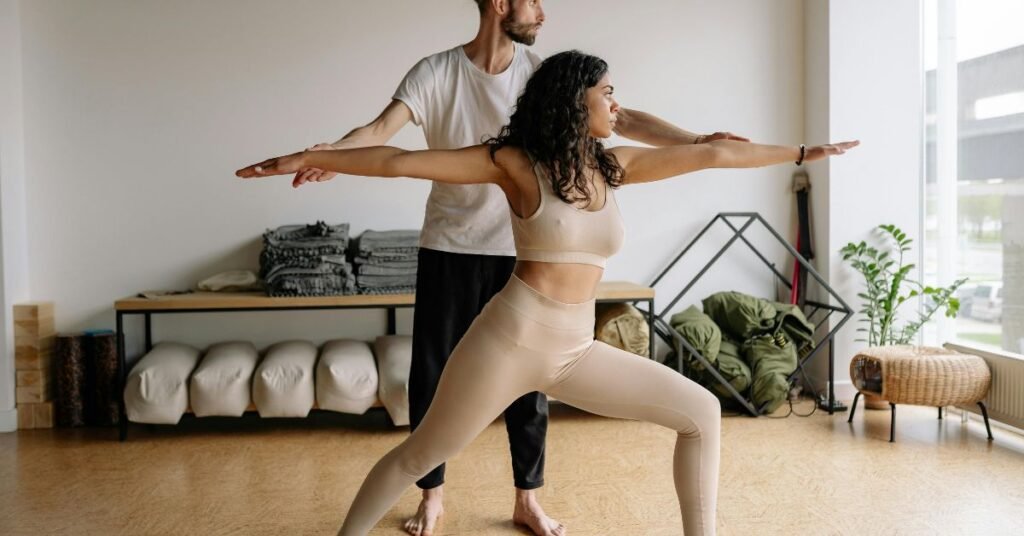
- Embody Tapas: Choose a pose you find slightly challenging—maybe a longer hold in Warrior Two. That feeling of slight discomfort that you choose to breathe through is your Tapas (discipline) in action, building your inner fire and resilience.
- Practice Satya: Be honest with yourself about your alignment and your limitations. Don’t use your body to feed your ego.
2. The Energy Practice: Using Prāṇāyāma for Emotional Regulation
Your breath is always with you. Use it to practice Pratyāhāra (sense withdrawal) and Dhāraṇā (concentration).
- Traffic Light Breathing: The next time you are stuck at a red light, don’t reach for your phone. Instead, practice a 4-7-8 breath: Inhale for a count of 4, hold for a count of 7, and exhale for a count of 8. Do this three times. You are using the physical breath to send a spiritual signal to your nervous system: “Everything is fine; you are safe.” This is a powerful act of self-regulation and Santosha (contentment).
- Before a Big Moment: Before a difficult conversation or a stressful meeting, close your eyes for 60 seconds and simply observe your breath without changing it. This is pure Dhyāna (meditation), creating a small pocket of stillness before you act.
3. The Mind Practice: Living the Yamas and Niyamas
These are the most powerful, most challenging, and most constant spiritual practices.
| If you are struggling with… | Practice this Limb… | Real-Life Application |
| Gossip or Negative Self-Talk | Satya (Truthfulness) | Before speaking, ask yourself: Is it true? Is it necessary? Is it kind (Ahimsa)? If you can’t say “yes” to all three, be silent. |
| Feeling Overwhelmed by Stuff | Aparigraha (Non-Possessiveness) | Clear one drawer, one shelf, or one folder on your desktop. The physical decluttering mirrors the spiritual clarity you are seeking. |
| Constant Worry/Anxiety | Īśvara Praṇidhāna (Surrender) | Acknowledge the worry. Then, consciously hand it over: “I have done what I can. I release the outcome to the universe/God/Higher Power.” This is a spiritual letting go. |
| Resentment or Victimhood | Santosha (Contentment) | Start a daily gratitude list—not just for the big things, but the ridiculously small ones: a hot cup of tea, a good pen, a parking spot. Training the mind to look for the good is the ultimate spiritual alchemy. |
| Lack of Direction/Focus | Svādhyāya (Self-Study) | Spend five minutes at the end of the day journaling one thing you learned about yourself that day. No judgment, just observation. This builds self-awareness—the key to spiritual growth. |
Part 6: Conclusion — Your Life is the Ultimate Yoga Pose
If you take only one thing away from this deep dive, let it be this: Yoga is a holistic system of self-discovery, and the spiritual path is accessible to everyone.
You don’t need a perfectly toned body, a guru on a mountain, or even a fancy yoga mat. All you need is a willingness to look inward and to start practicing the principles of kindness, truthfulness, discipline, and contentment in your everyday life.
The asana is a physical ritual that helps you connect with your body, but the Yamas and Niyamas are the daily, constant rituals that connect you with your soul. They are the quiet, steady practices that transform the external chaos of the world into the internal peace of the Puruṣa—the true, blissful, unchanging Self that has been waiting patiently for you all along.
The journey from the mat to the soul is not a sprint; it’s a lifetime of gentle, dedicated, and loving effort. And every single breath you take can be a powerful step down that path. Your life is not a distraction from your spiritual practice—your life is the practice.
So, the next time you step onto your mat, or even just sit down at your desk, remember the profound, ancient wisdom that lies beneath the surface of the stretch. You’re not just strengthening your core; you’re strengthening your soul. You are moving, quite literally, from a state of being lost to a state of being united—and there is no greater spiritual growth than that.
Now go breathe!

Theo is a dedicated yoga instructor with over six years of experience guiding individuals toward balance, strength, and inner peace through the transformative practice of yoga.As the founder of Pure Yoga Vibes, Theo offers expert insights, inspiring routines, and a wealth of knowledge to support your wellness journey. Committed to fostering a space for growth and mindfulness, Theo’s mission is to make yoga accessible, enjoyable, and meaningful for everyone.
For inquiries or collaborations, feel free to reach out at contact@pureyogavibes.com.