The Secret Sauce for a Happier Life? It Might Just Be in Your Downward Dog.
Introduction: More Than Just Stretching
Let’s be honest. We’ve all been there. You scroll through social media, seeing picture-perfect lives, and suddenly your own day feels a little… meh. The traffic was bad, your coffee got cold, and your to-do list seems to be multiplying like rabbits. In a world that constantly encourages us to chase the next big thing—the better job, the bigger house, the perfect body—it’s easy to fall into the habit of focusing on what we lack rather than what we have.
This is where two ancient, powerful practices step in: Yoga and Gratitude.
You might think of yoga as just a way to touch your toes or achieve a ridiculously complicated pretzel shape. And you wouldn’t be entirely wrong! It does help with flexibility. But that’s like saying a diamond is just a shiny rock. Yoga is a profound practice that connects your mind, body, and breath. When you consciously weave the practice of gratitude into your yoga routine, you transform your mat from a simple exercise spot into a sacred sanctuary—a space where you actively choose joy, appreciation, and peace.
The truth is, both gratitude and yoga are essentially about presence. Gratitude pulls your focus away from past regrets or future anxieties and plants it firmly in the goodness of the present moment. Yoga does the exact same thing by forcing you to pay attention to your breathing, your balance, and the sensation in your muscles right now.
So, if you’re ready to ditch the endless cycle of “if only” and embrace the powerful, simple magic of “thank you,” you’re in the right place.
What You Can Expect From This Heart-Centered Guide:
We’re going on a deep dive, a real, practical journey to show you how to turn your next yoga session into a powerful gratitude practice. This isn’t just theory; it’s a toolbox of simple techniques you can use today. By the end of this comprehensive guide, you’ll understand:
- The surprisingly strong connection between movement and thankfulness.
- Specific, easy-to-use mantras and intentions for your practice.
- How to find gratitude for your body—even the parts that feel tight or grumpy.
- Simple breathwork (Pranayama) that instantly shifts your mood.
- Ways to integrate this feeling of thanks into your entire day, not just your hour on the mat.
Get ready to breathe, stretch, and start saying a genuine, heartfelt ‘thank you’ to the universe, one pose at a time.
🧐 Section 1: Why Bother Combining Yoga and Gratitude? The Unexpected Synergy
You’re already busy. You already have a million things to do. Why add one more thing—a whole new layer of “being grateful”—to your already packed yoga session? Isn’t just getting to class enough?
It’s a fair question, and the answer is simple yet transformative: Synergy.
When two things work together and create a result greater than the sum of their individual parts, that’s synergy. Think of peanut butter and jelly—good alone, magnificent together. Yoga and gratitude are like that.
The Scientific Side of ‘Thank You’
This isn’t just some airy-fairy, feel-good concept. Research backs this up.
- Gratitude Re-wires Your Brain: Psychologists and neuroscientists have shown that regularly practicing gratitude actually shifts your neural pathways. It trains your brain to notice the good things, making you less susceptible to stress, anxiety, and depression. You literally become an optimist factory.
- Yoga Calms Your Nervous System: The slow, conscious movements and deep breathing in yoga activate your parasympathetic nervous system—the body’s “rest and digest” mode. This is the opposite of the “fight or flight” stress response. When your body is relaxed, your mind is open.
- The Perfect Storm for Joy: When you combine a calm, open, de-stressed body (from yoga) with a positively focused, seeking-the-good mind (from gratitude), you create the perfect internal environment for genuine, lasting happiness. The movement deepens the feeling, and the feeling enriches the movement.
The Magic of the Mat: Stopping the ‘Zoom-Out’ Effect
One of the biggest problems in modern life is the “Zoom-Out” effect. We live our lives in a constant wide shot, thinking about the grocery list, the meeting tomorrow, the argument from yesterday. We’re never truly here.
Your yoga mat is the antidote. It forces you to zoom in.
- You Feel Your Feet: In Mountain Pose (Tadasana), you’re instructed to feel the four corners of your feet grounding down. This simple act brings you immediately into your body and out of your head.
- You Feel Your Breath: When you focus on your Ujjayi breath (the ocean sound), you stop thinking about email and start thinking about the air moving in and out of your lungs.
This is the crucial link: Once your mind is anchored by your breath and body, it’s no longer racing. It’s available for a higher, more positive focus. It’s available to say, “Wow, I am actually capable of standing on one leg. Thank you, strong legs.” or “Thank you, breath, for keeping me alive.”
Your mat is a low-pressure environment where you can safely experiment with deep appreciation. The goal isn’t to be perfectly flexible; the goal is to be perfectly present. And once you are present, gratitude is the most natural emotion that follows.
🌟 Section 2: Setting the Stage: Intentions and Mantras to Begin Your Practice
A yoga practice without an intention is like driving without a destination—you’ll still be moving, but you won’t get anywhere specific. An intention (Sankalpa) is a positive, present-tense statement that sets the tone for your practice. When that intention is gratitude, the entire practice shifts.
The Power of the Opening Breath
Before you even move into your first pose, take three slow, deep breaths in a comfortable seated position. Use this precious moment to plant the seed of thanks.
1. Choose Your Intention: Make it simple, personal, and powerful. Avoid vague ideas.
- Instead of: “I want to be grateful.” (Too vague, future tense)
- Try: “I am grateful for this body that moves me.” (Specific, present tense)
- Try: “I choose to notice one good thing today.” (Actionable, present tense)
2. Whisper a Personal Dedication: Take the practice beyond yourself. Dedicate the strength, peace, or energy you gain to someone else.
- Example: “I dedicate this hour of self-care to my mother, who taught me to be strong.” or “I dedicate this practice to anyone struggling to find peace.”
This small act instantly transforms a self-focused workout into a selfless, compassionate action—a powerful form of gratitude for the people in your life.
Simple Mantras to Carry You Through the Flow
A mantra is a word or sound repeated to help you concentrate. During a challenging flow, your mind will try to wander, complain, or tell you you’re not good enough. Mantras are your secret weapon against the inner critic.
You don’t need to chant Sanskrit. You just need a simple phrase that reminds you of your intention.
| Pose/Moment | Simple Gratitude Mantra | When to Use It |
| Inhale | “Thank You” | On every inhale, consciously breathing in the good. |
| Exhale | “Let Go” | On every exhale, releasing tension or negative thoughts. |
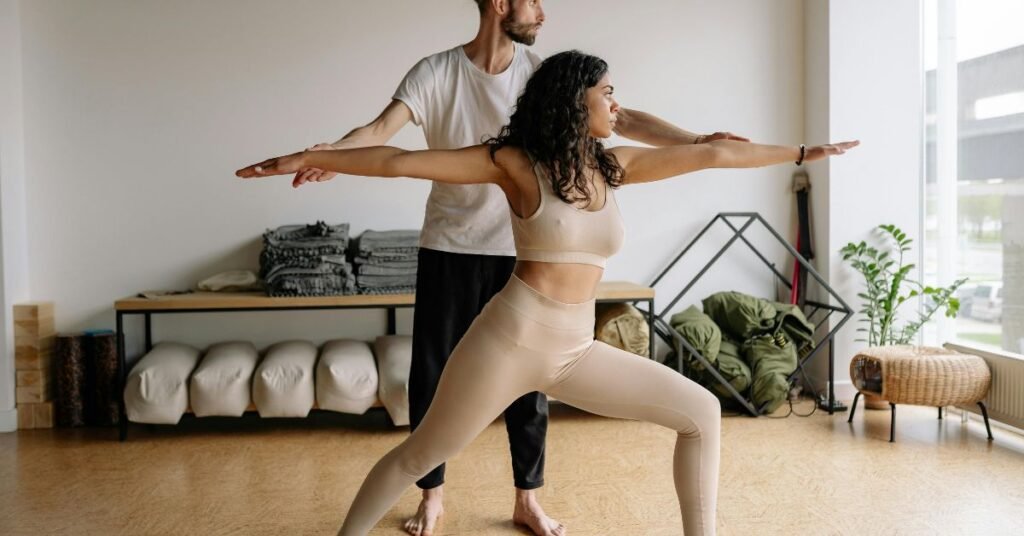
| Challenging Pose | “I Am Strong” | When your muscles start shaking in Warrior II or Plank. |
| Resting Pose | “I Am Safe” | In Child’s Pose or Savasana, appreciating your peace. |
| Standing Tall | “I Am Here” | In Mountain Pose, appreciating your presence. |
The key is repetition. If you repeat “I am strong” 20 times during a tough sequence, your brain starts to believe it. This shifts your focus from the pain or struggle to the amazing capability you possess right now. That shift is pure gratitude in action.
💖 Section 3: Gratitude for the Body: Finding Thankfulness in the Physical Practice
Here’s a hard truth: Most of us spend more time criticizing our bodies than appreciating them. We focus on the soft spots, the wrinkles, the parts that hurt, or the things they can’t do.
Yoga, practiced through the lens of gratitude, becomes a powerful counter-narrative to self-criticism. It teaches you to appreciate your body not for how it looks, but for how it serves you.
Appreciating the ‘Unsexy’ Parts
In any yoga class, there will be poses you love and poses that feel awkward or painful. A gratitude practice insists that you show equal kindness to both.
- In Forward Fold (Uttanasana): Instead of thinking, “Ugh, my hamstrings are so tight,” try thinking, “Thank you, legs, for holding me up all day.” Acknowledge the incredible service they provide.
- In Plank Pose: Instead of, “My arms are on fire,” try, “Thank you, core, for the stability that keeps me whole.” Feel the stability, not just the burn.
- In a Twist: When you feel the tension releasing in your back, take a moment to be grateful for the spine, the amazing structure that allows you to bend and move through the world.
Note: This doesn’t mean ignoring pain. If something genuinely hurts, stop and adjust! Gratitude is not ignoring reality; it is being kind within it. Be grateful for the wisdom of your body that sends a clear signal to stop.
The Posture of Thanks: Heart Openers
In yoga philosophy, the heart chakra (Anahata) is the center of love, compassion, and gratitude. Poses that physically open the chest often create an emotional opening as well.
When you practice a Heart Opener, consciously link the physical opening with an emotional feeling of “giving thanks.”
- Cobra or Upward-Facing Dog: As you lift your chest, imagine your heart space expanding, physically opening up to receive and give thanks. Be grateful for the support of the earth beneath you.
- Bridge Pose (Setu Bandhasana): As you lift your hips, imagine your chest lifting toward the sky, breathing in a feeling of deep appreciation for the simple things: a roof over your head, a friend who calls, a sunny day.
These poses are not just stretches; they are physical expressions of emotional openness. They are literal ways to “wear your heart on your chest” in a beautiful, grateful way.
🌬️ Section 4: The Breath of Gratitude: Using Pranayama to Shift Your Mood
The breath (Prana) is the life force, the most basic, undeniable thing we have to be grateful for. Seriously, take a moment: you didn’t have to remember to take your last breath. Your body just did it for you. What a gift!
In yoga, we don’t just breathe; we practice Pranayama, which means “extension of the life force or breath.” When you control your breath, you control your nervous system, and when you do that, you can consciously choose gratitude over anxiety.
The Instant Gratitude Breath: Sama Vritti (Equal Ratio Breathing)
This is one of the easiest and most powerful techniques to calm your mind and create a stable foundation for gratitude.
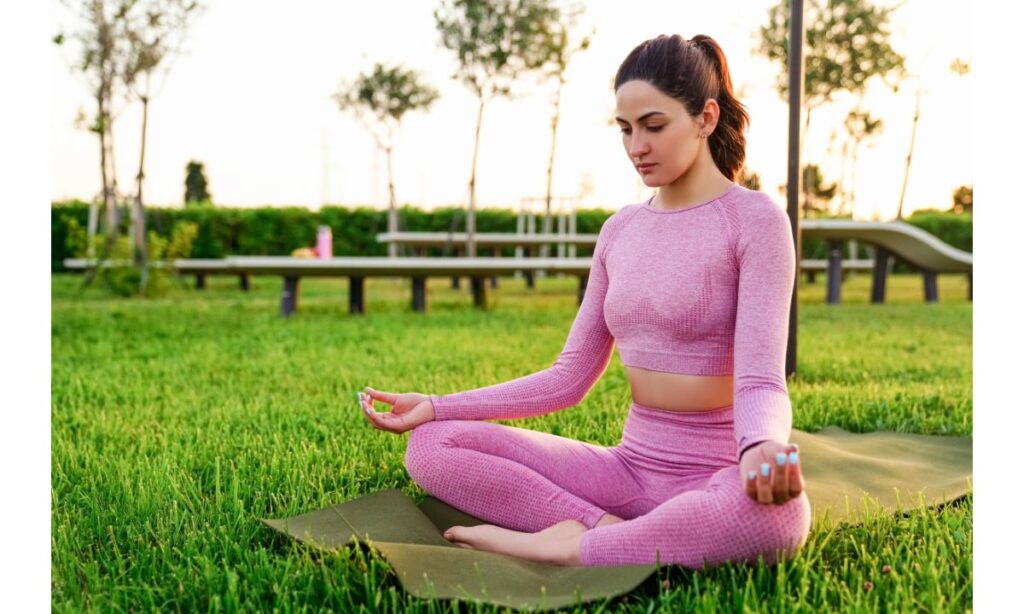
- Find a Comfortable Seat: Sit tall, close your eyes, and relax your shoulders.
- Inhale Count: Inhale slowly and steadily to a count of four (1-2-3-4). As you inhale, mentally say, “I am receiving.”
- Exhale Count: Exhale slowly and steadily to the exact same count of four (4-3-2-1). As you exhale, mentally say, “I am thankful.”
- Repeat: Continue for 10–20 rounds.
This rhythm is soothing, and the mental pairing of “receiving” and “thankful” reinforces the core idea of gratitude: that life’s gifts are constantly flowing toward you. This practice interrupts any negative thought spirals and grounds you in the simple gift of life.
Deepening the Appreciation: Diaphragmatic Breathing
Most of us are “chest breathers,” taking shallow sips of air. Diaphragmatic (belly) breathing is a deeper, more restorative form that instantly calms the body—and a calm body is a grateful body.
- How to Do It: Lie on your back with one hand on your chest and the other on your belly. Inhale slowly through your nose, making sure the hand on your belly rises, while the hand on your chest stays relatively still. Exhale completely, letting the belly fall.
- The Gratitude Link: When you feel your belly rise and fall, think about all the hidden, vital processes your body handles without you having to ask: your heart beating, your blood circulating, your cells regenerating. Be grateful for the unseen miracle that is your biological self. This is a profound, fundamental level of thankfulness.
🌙 Section 5: The Sweetest Part: Savasana and The Gratitude Checklist
If you’ve ever skipped Savasana (Corpse Pose) at the end of class, you’ve missed the most important part! Savasana is the moment of integration. It’s where the work you just did sinks into your mind and body. This is the ultimate moment for gratitude practice.
Integrating the Goodness
When you lie down in Savasana, give yourself permission to be completely still. This stillness is a powerful expression of thanks for the ability to rest.
The Simple Savasana Gratitude Checklist:
Instead of letting your mind wander to the evening’s dinner plans, gently guide it through a simple appreciation checklist.
- Thank the Body: Mentally scan your body from your toes to the top of your head. Say a simple “thank you” to each part:
- Toes and Feet: Thank them for grounding you.
- Hands and Arms: Thank them for reaching, holding, and hugging.
- Heart and Lungs: Thank them for the constant, tireless work.
- Mind: Thank it for the capacity to learn and be present.
- Thank the Space: Be grateful for the environment:
- The comfortable mat beneath you.
- The warm/cool air touching your skin.
- The peaceful silence (or even the gentle sounds) around you.
- Thank the Opportunity: Be grateful that you had the time, the health, and the resources to dedicate an hour (or even five minutes) solely to your well-being. This is a privilege, not a given.
The Ultimate Posture of Humility
In Savasana, you are literally lying on the ground, vulnerable and open. This is the posture of humility. It reminds us that we are just a small, yet beautiful, part of a huge universe.
When you practice Savasana with gratitude, you let go of the ego that was worried about looking good in the poses. You simply rest in the truth that you are enough, right here, right now. And there is nothing more to do but be thankful for that simple, profound truth.
💡 Section 6: Taking It Off the Mat: Gratitude as a Daily Lifestyle
The true measure of a yoga practice isn’t how far you can bend; it’s how you live your life after you roll up your mat. The goal is to make gratitude less of a scheduled practice and more of a way of seeing the world.
Creating ‘Mini-Mat’ Moments
You don’t need an hour, a quiet room, or fancy leggings to practice gratitude. You can use simple, everyday moments as anchors for thankfulness. Think of these as “mini-Savasanas” or “mini-Intentions.”
- The Traffic Light Anchor: When you hit a red light, instead of sighing in frustration, use the pause to take three deep breaths and quickly name three things you are grateful for right now (e.g., my working car, the music I’m listening to, the cup of coffee beside me).
- The Hand Washing Ritual: As you wash your hands, appreciate the clean, running water, the ability to sanitize and care for your health, and the fact that you have use of your hands.
- The First Sip of Coffee/Tea: Don’t just gulp it down. Hold the warm mug, smell the aroma, and take a moment of thanks for the luxury of a warm, comforting drink. This is instant, accessible mindfulness.
A Gratitude Journal is Your Mental ‘Yoga Studio’
If your mat is your physical studio, your journal is your mental studio. It’s where you train your mind to stop focusing on the negative noise and actively seek the good.
- The “Three Good Things” Rule: At the end of the day, commit to writing down just three things—no matter how small—that went well or that you felt grateful for.
- It doesn’t have to be monumental: “The sun came out for five minutes,” “I remembered to take out the trash,” “My boss smiled at me.”
- The “Thank You to the Tough Stuff” Challenge: Be grateful for the challenges in your life. Did a meeting get cancelled? Thank the universe for the extra hour it gave you. Did you have a disagreement? Be grateful for the relationship that is strong enough to withstand it. This is advanced gratitude, but it is incredibly freeing.
The most important guideline here is consistency, not intensity. A few minutes of genuine, everyday gratitude practice is infinitely more powerful than one long, forced session.
🥳 Conclusion: Roll Up Your Mat and Carry the Light
We’ve come to the end of our journey, but the true practice is just beginning.
Yoga and gratitude are two sides of the same beautiful coin. Yoga tames the restless body and mind, creating a calm, fertile ground. Gratitude is the seed of joy and appreciation planted in that ground.
This is not about being fake or forcing a smile when you don’t feel like it. This is about gently, consistently choosing to notice the good that is already there. It’s about looking at your hands in Downward Dog and saying, “Thank you for holding me up,” and then carrying that attitude of appreciation with you when you leave the studio.
The simple realization that you are alive, you can breathe, and you can move is a gift worthy of profound thanks. Start small, be kind to yourself, and watch as your inner “Thank You” begins to light up your entire world.
Now, go forth, breathe deep, and practice your gratitude, on and off the mat!

Theo is a dedicated yoga instructor with over six years of experience guiding individuals toward balance, strength, and inner peace through the transformative practice of yoga.As the founder of Pure Yoga Vibes, Theo offers expert insights, inspiring routines, and a wealth of knowledge to support your wellness journey. Committed to fostering a space for growth and mindfulness, Theo’s mission is to make yoga accessible, enjoyable, and meaningful for everyone.
For inquiries or collaborations, feel free to reach out at contact@pureyogavibes.com.